The Breakfast Table That Never Left: Stories Behind South India's Most Comforting Morning Meals
There's a particular kind of homesickness that hits hardest in the morning.
It's not the big, dramatic kind. It's the quiet kind — the kind that shows up when you're standing in your apartment in Houston or Chicago or Fremont, and you realize the smell of something steaming in the kitchen is missing. The smell of idli warming, of dosa batter hitting a hot griddle, of upma thickening in a pot. That smell. That specific, irreplaceable smell.
For millions of South Indians living in the US, breakfast isn't just a meal. It's a thread back to something real.
At Padappai Brothers, we talk a lot about flavor. But today, we want to talk about what's underneath the flavor — the history, the family, the meaning behind the dishes that have anchored South Indian mornings for generations.
Idli: The Oldest Fast Food You've Never Thought About That Way
If you look up the earliest written references to idli, you'll find mentions going back to the 10th century in Kannada literature. That's over a thousand years of the same dish — steamed, soft, round, and deeply humble.
What makes idli remarkable isn't its ingredients (just rice and urad dal, fermented overnight). It's the process. Fermentation is the original slow food. You can't rush it. You can't microwave it into existence. You mix the batter, you let it sit, and you trust it.
For a lot of South Indian families who immigrated to the US in the 70s, 80s, and 90s, learning to ferment idli batter in an American kitchen was an act of stubbornness and love. The climate is different here. The humidity is different. Some aunties swear by putting the batter in the oven with just the light on. Others wrap the bowl in a blanket. Everyone has a workaround, and everyone is convinced theirs is the right one.
That improvisation — that refusal to let the dish die just because the conditions changed — is something we find genuinely moving.
What it means at the table: Idli is Sunday morning. It's the dish that says there's no rush today. It's eaten with coconut chutney, sambar, and sometimes a drizzle of ghee that your doctor would probably prefer you not mention.
Dosa: The Dish That Travels
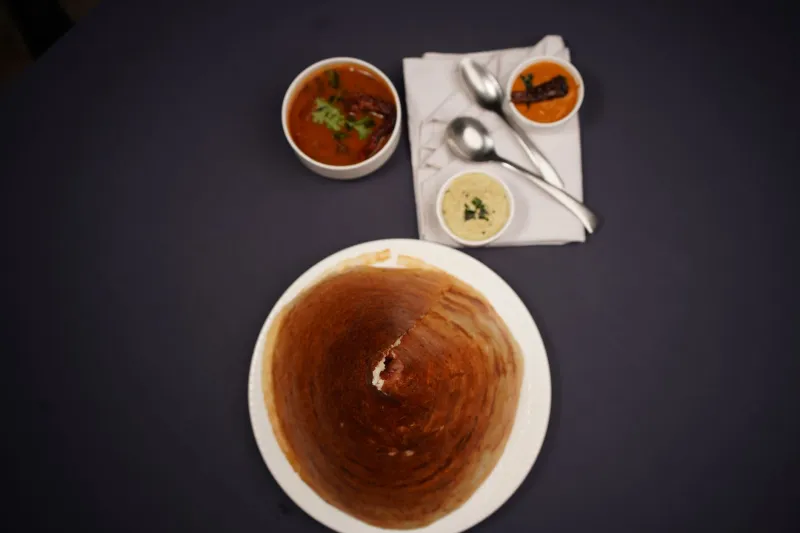
If idli is a Sunday morning, dosa is a Saturday night. Thin, crispy, golden-edged dosa has a kind of showmanship to it. Watching a skilled cook spread batter in concentric circles on a hot griddle is genuinely satisfying — there's a reason dosa-making videos go viral.
The dish likely originated in the Udupi region of Karnataka, though Tamil Nadu has staked a very enthusiastic claim. (We'll stay out of that debate.) What's undeniable is that dosa has traveled further and wider than almost any other South Indian dish. It's on menus in London, Singapore, Dubai, and increasingly, in mainstream American cities.
But the dosa that matters most isn't the one at a trendy restaurant. It's the one your mom made at 7 a.m. with leftover batter, slightly thicker than ideal, served on a stainless steel plate with a smear of chutney from the fridge. That dosa.
For second-generation South Indian Americans, learning to make dosa is often a rite of passage — and a humbling one. Getting the batter spread thin enough, the heat right, the timing down — it takes practice. But when it works, there's nothing quite like it.
Upma: The Underdog Breakfast
Let's be honest: upma doesn't get the respect it deserves.
Made from roasted semolina (rava) cooked with mustard seeds, curry leaves, onions, and whatever vegetables are in the fridge, upma is the weekday breakfast. The practical one. The one that takes fifteen minutes and uses what you have.
In India, upma has a reputation as a humble dish — sometimes a punchline, even. There's a running joke in Tamil households that upma is what happens when there's "nothing" to eat. But that joke is really a compliment in disguise. Because upma is what a good cook makes when resources are limited, and it's delicious every time.
For diaspora families, upma is often the first dish kids learn to make on their own — simple enough to be accessible, forgiving enough to survive mistakes. It's also one of those dishes that, when you smell it cooking, takes you somewhere specific. A school morning. A grandmother's kitchen. A particular Tuesday that you didn't know you'd remember.
Pongal: When Breakfast Becomes a Celebration
Of all the dishes on this list, pongal carries the most ceremony.
The dish — creamy, soft rice cooked with moong dal, black pepper, cumin, and ghee — shares its name with one of the most important harvest festivals in Tamil culture. Every January, families across Tamil Nadu (and Tamil diaspora communities across the US) cook pongal outdoors in clay pots, letting it boil over as a symbol of abundance.
But pongal is also just breakfast. A very good, very comforting breakfast that warms you from the inside out on a cold morning.
The version eaten during the festival (ven pongal, the savory kind) is traditionally served with coconut chutney and sambar. There's also a sweet version (sakkarai pongal) made with jaggery and cashews, which is its own kind of wonderful.
For Tamil families in cities like Atlanta, Dallas, and the Bay Area, making pongal during the festival season is one of the most deliberate acts of cultural preservation they practice. It's not just about the food. It's about gathering, about explaining the ritual to kids who grew up here, about keeping something alive.
Why These Dishes Matter Now
We started Padappai Brothers because we believe South Indian food deserves to be understood, not just consumed. These breakfast dishes are a perfect example of why.
They're not complicated. They're not exotic. They're just real — rooted in centuries of tradition, shaped by family, and capable of crossing an ocean without losing what makes them special.
If you've been meaning to try making any of these at home, start here. Start with the story. The recipe will follow.